
A new model enters the market. The product brochure is printed. The campaign is ready. Dealers are informed. And yet one central question remains:
Is the sales force truly prepared, or merely informed?
Especially with compact, urban-positioned models like the Renault Twingo, success is not determined by technical specifications, but by the ability of salespeople to communicate benefit-driven arguments precisely, confidently and target-group oriented.
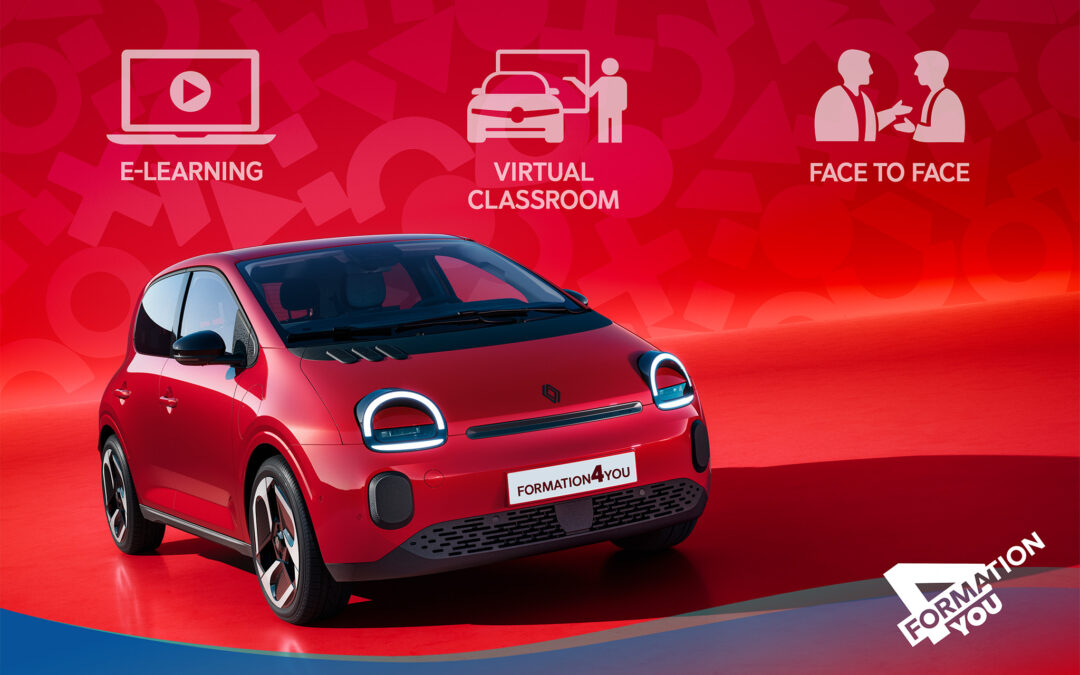
That is why, for the launch of the new Renault Twingo, we developed a clear and economically designed training architecture.
For economic decision-makers, this means:
- reduced friction in rollout
- faster argumentation confidence at dealerships
- higher consulting quality
- improved conversion rates
- sustainable competence instead of one-time knowledge transfer
The architecture follows a clear principle: Know – Understand – Apply.
Step 1: E-Learning – Building a scalable knowledge foundation
The first phase intentionally begins asynchronously.
The goal is not excitement. The goal is foundation.
The e-learning conveys:
- product positioning
- target groups
- key technical data
- competitive comparison
- core sales arguments
Advantages for companies:
- flexible completion
- consistent knowledge level
- measurable learning progress
- reduced training time in synchronous formats
All participants enter the next stage with the same baseline.
Step 2: Virtual Classroom Training – Developing argumentation strength
In the virtual classroom, the vehicle is physically present in the studio.
No abstract product slides. No purely frontal format.
Instead:
- live vehicle presentation
- concrete benefit-based argumentation
- objection handling
- sales conversation simulations
- competitive positioning
The trainer works directly on the vehicle. Details become visible.
Arguments are refined.
For economic decision-makers, this phase means:
- high scalability
- low travel costs
- high interactivity
- fast rollout capability across the dealer network
This is where confidence is built. This is where knowledge becomes conviction.
Step 3: Face-to-Face – Training behavior
The third phase is optional but strategically valuable.
It is no longer about product knowledge. It is about behavior in the sales process.
Focus areas:
- live sales conversations
- role plays
- price argumentation
- handling comparison offers
- emotional product presentation
Why this phase is decisive:
Sales is not a knowledge competition.
Sales is impact in conversation.
And impact only develops through practice.
The economic value of the three-stage structure
For decision-makers, the benefits are clear:
- Efficiency: Basic knowledge is delivered digitally and at scale. On-site time is used strategically.
- Quality assurance: A consistent knowledge and argumentation standard across the network.
- Sustainability: A repeatable structure for future model rollouts.
- Flexibility: Internal resources can be integrated or complemented by external expertise.
Conclusion: A model does not sell itself.
Especially in the urban segment, it requires salespeople who radiate confidence.
Confidence comes from structure.
Structure comes from architecture.
The three-stage training architecture, as implemented for the launch of the new Renault Twingo, demonstrates how product launches can be executed economically smart, didactically sound and sales-effective.
Because market success does not begin with delivery. It begins with enablement.
Are you planning a product launch soon? We look forward to connecting with you.