
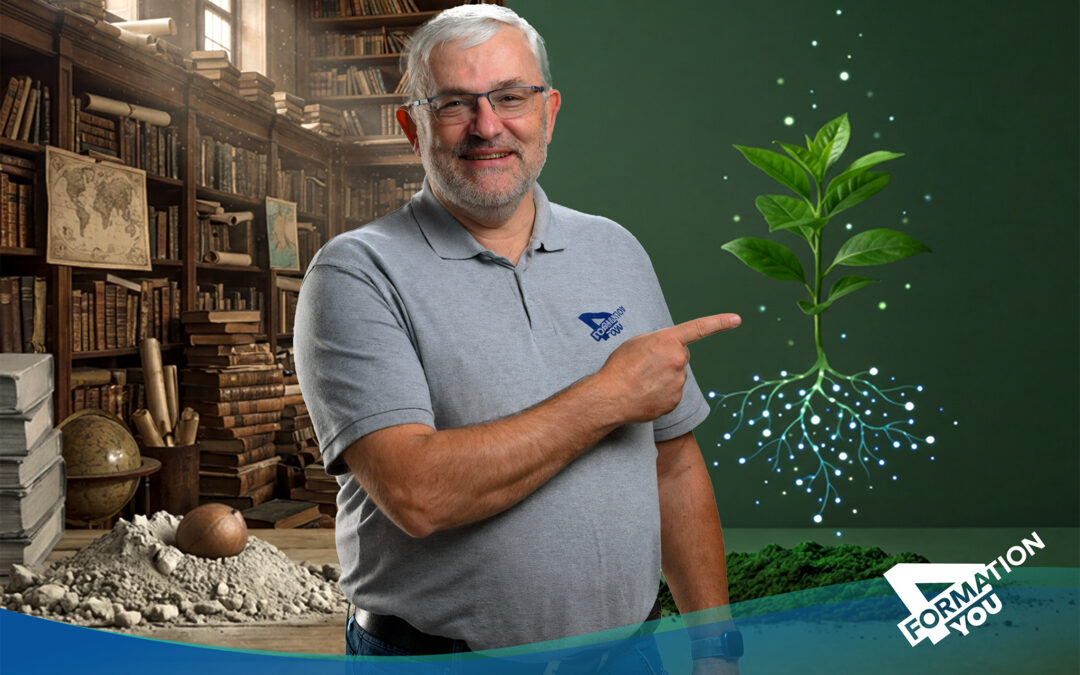
Organisational development begins where knowledge becomes effective
When we talk about organisational development today, we rarely mean structures, processes, or strategies alone. We are talking about something more fundamental: the ability of organisations not just to generate knowledge, but to make it work.
Because knowledge is available everywhere today. Impact is not.
In many organisations, I observe a paradox: never before has so much knowledge been available – and yet so little of it actually guides action. Documentation is created, training is delivered, systems are implemented – and still the decisive question often goes unanswered: what actually changes behaviour in everyday practice? That, for me, is precisely where organisational development begins.
Knowledge is not content. Knowledge is a process.
A widespread misconception is to think of knowledge management as a storage problem. Where do we save information? How do we structure data? Which tools do we use? But that falls short.
Knowledge only realises its value when it enters into interaction: with people, with context, with concrete challenges. It emerges through action, through dialogue, through reflection. And above all: it shows itself in decisions.
That is why at Formation4You we understand knowledge management not as a systems question, but as a design challenge. It is not about making knowledge available. It is about making it actionable.
Actionable for leadership. Actionable for client relationships. Actionable for collaboration.
The decisive interface: behaviour
Organisations do not change through concepts. They change through behaviour. And behaviour is not shaped by information alone, but by understanding, lived experience, and the ability to contextualise. That is precisely why our learning architectures are built on the connection between professional confidence, social competence, and personal impact.
This is particularly evident in areas such as customer service, sales, or leadership: the difference rarely lies in knowing what should be done. It lies in how it is put into practice in the specific situation.
How do I respond to feedback?
How do I build trust in a conversation?
? How do I make decisions under uncertainty?
These are not theoretical questions. They are questions we encounter again and again in practice.
Learning as part of value creation
When learning is understood as an isolated intervention, it often leaves no trace. When it is conceived as an integral part of value creation, impact follows.
That is why we develop programmes around real-world requirements – not in the abstract, but close to the situations that make the difference.
Blended learning, modular concepts, transfer formats: none of these are pedagogical indulgences. They are means to an end: designing knowledge so that it is accessible in everyday life.
Because the decisive metric is not the participation rate in training sessions. The decisive metric is the change in behaviour.
Organisational development is relationship design
One aspect is often underestimated: knowledge does not spread through systems – it spreads through relationships.
People do not adopt attitudes, ways of thinking, or ways of working because they are documented. They adopt them because they are experienced. Because they are lived and modelled. Because they can be shaped to fit their own reality.
This means: organisational development is always also relationship design.
Between leader and team.
Between company and clients.
Between aspiration and lived practice.
When these relationships are strong, a space is created in which knowledge can circulate. When they are not, it remains static.
Conclusion: from knowledge to effectiveness
The central question for organisations today is no longer: What do we know?
But: What of that actually makes THE difference?
Organisational development and knowledge management meet at precisely this point. Where knowledge transitions into action. Where information becomes orientation. Where people are enabled to be effective.
Or put another way:
It is not knowledge that determines an organisation’s success.
It is what the organisation does with it.